JobMix Concrete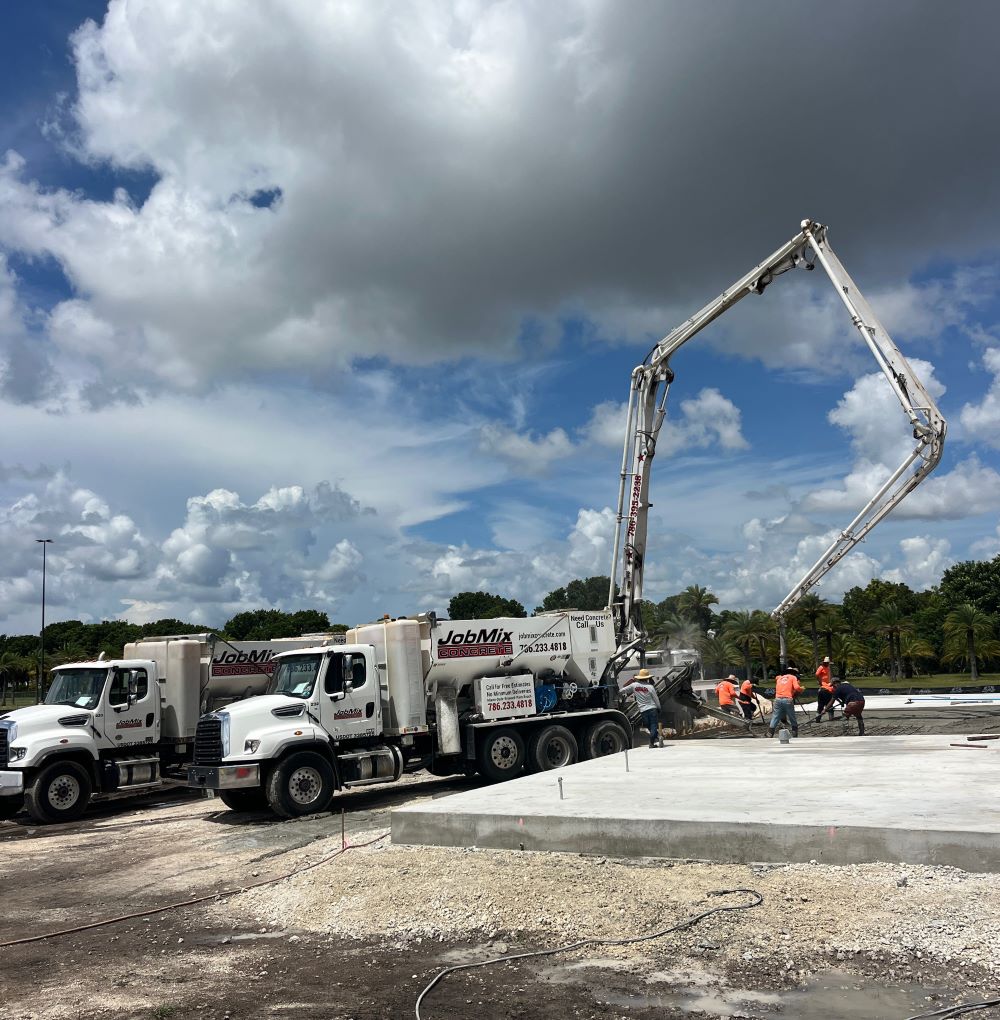
Large construction sites run on timing. One delay affects the next crew, then the next phase, and suddenly the entire schedule starts slipping. That pressure is one reason contractors lean heavily on concrete pumping for commercial and industrial work.
Dragging concrete across a massive site with wheelbarrows or a basic chute system slows everything down. It also creates inconsistency. Crews get tired, placement becomes uneven, and the quality of the finish starts depending too much on manual handling.
Pumping changes that completely. Fresh concrete moves directly from the truck to the exact spot where crews need it. Faster movement. Cleaner placement. Less chaos on-site.
That matters when crews are working on warehouses, parking garages, towers, bridges, or large commercial developments where time and accuracy both carry weight.
Reaching Difficult Areas Without Slowing the Job
Some parts of a project are simply hard to access. A deep footing. An elevated slab. Tight corners surrounded by steel reinforcement. Multi-story structures with limited ground access. Those areas turn into a problem quickly if workers have to move material manually.
Those obstacles are much more simplified with the help of concrete pumping. Boom pumps are able to shoot very high up in the air and deliver material in unexpectedly precise locations.
Long horizontal running of line pumps do not require crews to keep repositioning equipment. Contractors do not battle the site layout, but improve on it.
The job is on the move. Such continuous stream is particularly necessary when pouring the concrete foundation since discontinuities may compromise structure uniformity.
Weak spots arise when they are not placed evenly or even delayed by pours, and are particularly common on bigger foundations that bear considerable weight.
Faster Concrete Pouring Means Better Workflow
Construction crews do not just think about speed. They consider coordination. Proper sequencing is vital to electricians, framers, steel crews, inspectors, finishers, and equipment operators. It takes too long to pour concrete, which disorients several trades.
Pumping helps crews stay ahead of schedule without sacrificing quality. Concrete arrives continuously, which keeps finishing crews working instead of standing around waiting for the next load. The placement process feels smoother and far more controlled.
On larger sites, that efficiency saves serious money over time. Less downtime also means fewer rushed corrections later. Contractors would rather place concrete correctly the first time than spend days fixing avoidable mistakes after curing starts.
Labour Demands Drop Significantly
Manual concrete movement wears people down fast. It takes more workers, more physical effort, and more time to complete even routine pours on large projects. Pumping cuts a huge portion of that labour demand.
Instead of hauling heavy loads back and forth, crews can focus on levelling, finishing, vibration, and quality checks. The site becomes more organized because workers are not constantly moving through crowded areas carrying wet concrete.
That also improves safety. Busy construction sites already have enough moving equipment, active machinery, and tight working zones. Reducing unnecessary movement lowers the chance of injuries and site congestion.
Why Concrete Pumping Has Become the Standard
Large-scale construction keeps getting more demanding. Projects move faster now than they did years ago, and expectations around quality are much higher.
Contractors need methods that help them stay efficient without compromising structural performance. That is exactly why concrete pumping continues to dominate commercial construction work.
Conclusion
Professionals make the placement cleaner, steadier concrete pouring, improved workflow, and better access across difficult job sites.
For major structural work and concrete foundation pouring, those advantages make a noticeable difference long before the project reaches completion. On modern job sites, pumping is no longer viewed as a convenience. In many cases, it is simply the practical way to keep large projects moving.
Source: https://scooparticle.com/why-concrete-pumping-is-used-for-large-scale-projects/


 Ammar Saleem