Vasu Malhotra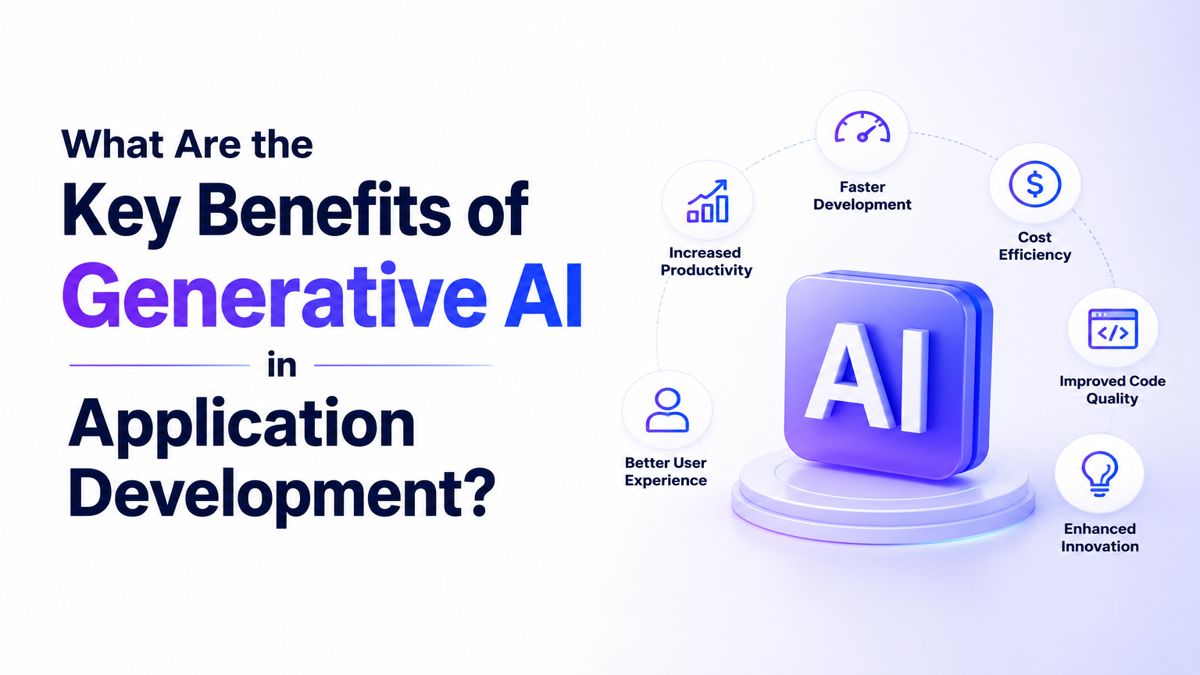
Generative AI is fundamentally changing how modern software applications are designed, developed, deployed, and scaled. In 2026, businesses are no longer treating artificial intelligence as an isolated feature or experimental innovation project. Instead, organizations across healthcare, fintech, ecommerce, logistics, cybersecurity, enterprise SaaS, education, and manufacturing are integrating generative AI directly into core application architecture to improve automation, accelerate development cycles, personalize user experiences, and create intelligent digital ecosystems capable of adapting in real time.
The rise of generative AI in application development is not simply about adding chat functionality to mobile or web applications. Modern AI-native applications now support intelligent workflow automation, AI copilots, semantic search systems, predictive analytics, autonomous AI agents, content generation, operational intelligence, and conversational user interfaces. These capabilities are helping businesses improve productivity, reduce operational costs, scale customer engagement, and accelerate digital transformation initiatives at unprecedented speed.
At the same time, generative AI is also transforming the software development lifecycle itself. Development teams increasingly use AI-powered systems to automate coding tasks, improve testing workflows, optimize infrastructure management, generate documentation, streamline DevOps operations, and accelerate deployment pipelines. This is dramatically reducing development timelines while enabling engineering teams to focus on higher-value architectural and operational priorities.
However, realizing the full benefits of generative AI in application development requires more than integrating a language model into an existing product. Businesses must combine AI engineering with scalable cloud infrastructure, MLOps pipelines, vector databases, Kubernetes orchestration, observability systems, governance frameworks, and enterprise-grade security architecture. Organizations that approach AI strategically are gaining substantial competitive advantages in operational efficiency, scalability, customer experience, and product innovation.
This article explores the key benefits of generative AI in application development and explains how AI-powered systems are reshaping software engineering, digital products, enterprise operations, and customer engagement across industries.
Why Generative AI Is Transforming Application Development
Traditional software applications rely heavily on predefined workflows and manually programmed business logic. Developers explicitly define how systems respond to user actions, process data, automate operations, and manage workflows.
Generative AI introduces a completely different operational model.
Instead of depending entirely on rigid instructions, AI-powered applications can understand language, analyze context, generate dynamic outputs, automate reasoning tasks, retrieve information intelligently, and support adaptive decision-making. Applications become capable of operating more like intelligent assistants rather than static digital tools.
This shift dramatically expands what software applications can accomplish.
Modern AI-native applications can:
- Understand natural language queries
- Generate intelligent responses dynamically
- Automate repetitive workflows
- Personalize user experiences in real time
- Analyze operational data continuously
- Coordinate tasks autonomously
- Retrieve enterprise knowledge contextually
- Improve productivity across departments
- Support operational decision-making
- Adapt to changing user behavior
As a result, businesses across industries are increasingly investing in generative AI application development to improve operational scalability and digital competitiveness.
Faster Software Development Cycles
One of the biggest benefits of generative AI in application development is accelerated software engineering productivity.
Development teams increasingly use AI-powered coding assistants capable of generating boilerplate code, automating repetitive development tasks, suggesting optimizations, identifying bugs, generating documentation, and supporting debugging workflows.
This significantly reduces development time for many common engineering tasks.
For example, developers can use AI systems to:
- Generate API integrations
- Create frontend UI components
- Build backend service templates
- Write test cases
- Generate SQL queries
- Produce technical documentation
- Automate code refactoring
- Identify infrastructure issues
- Improve DevOps workflows
AI-powered development environments also improve onboarding efficiency for engineering teams because developers can access contextual assistance during implementation processes.
As development complexity increases across cloud-native applications, distributed infrastructure, and microservices ecosystems, AI-assisted engineering workflows are becoming increasingly valuable.
Improved User Experiences
Generative AI dramatically enhances application usability and personalization.
Traditional applications often rely on static interfaces and predefined workflows. In contrast, AI-powered applications can adapt dynamically based on user behavior, preferences, operational context, and interaction history.
Modern AI-native applications increasingly integrate:
- Conversational interfaces
- Intelligent assistants
- Personalized recommendations
- Context-aware workflows
- Adaptive user experiences
- AI copilots
- Real-time guidance systems
For example, ecommerce applications use generative AI to personalize shopping experiences dynamically. Enterprise SaaS platforms deploy AI assistants capable of automating workflows and helping users navigate operational systems. Healthcare applications use conversational AI to improve patient engagement and support remote care coordination.
This level of personalization improves engagement, user satisfaction, and long-term retention significantly.
Workflow Automation at Scale
Automation has become one of the most valuable enterprise use cases for generative AI.
Organizations across industries spend enormous amounts of time managing repetitive workflows involving reporting, documentation, communication, scheduling, analytics, customer support, and operational coordination.
Generative AI enables businesses to automate many of these tasks intelligently.
AI-powered applications can:
- Summarize documents
- Generate reports
- Automate customer responses
- Coordinate workflows
- Trigger operational actions
- Process enterprise data
- Organize information
- Handle repetitive support requests
- Generate content dynamically
- Assist with internal operations
AI agents further expand automation capabilities by enabling applications to execute multi-step workflows autonomously across distributed systems and APIs.
This improves workforce productivity while reducing operational overhead significantly.
Enhanced Decision-Making and Analytics
Generative AI enables applications to process and interpret operational data much more effectively than traditional software systems.
Modern AI-powered analytics systems can:
- Analyze large datasets
- Summarize operational trends
- Generate business insights
- Detect anomalies
- Forecast outcomes
- Explain patterns
- Support executive reporting
- Improve operational intelligence
Instead of relying solely on static dashboards, users can interact with analytics systems conversationally using natural language.
For example, executives can ask AI-powered business intelligence platforms operational questions directly and receive contextual summaries, forecasts, and recommendations instantly.
This dramatically improves decision-making speed and organizational agility.
Personalized Customer Engagement
Customer expectations have changed substantially in recent years. Users increasingly expect intelligent, responsive, and highly personalized digital experiences.
Generative AI enables businesses to deliver personalization at scale.
Applications can analyze:
- User behavior
- Purchase patterns
- Interaction history
- Contextual signals
- Operational preferences
- Engagement trends
Using this information, AI systems dynamically personalize recommendations, content delivery, support interactions, onboarding workflows, and product experiences.
This improves customer engagement while increasing conversion rates and retention across digital platforms.
Intelligent Enterprise Search and Knowledge Retrieval
One of the most important enterprise benefits of generative AI involves intelligent knowledge retrieval.
Traditional enterprise search systems often struggle because they rely heavily on keyword matching and fragmented information architecture.
Modern generative AI applications increasingly use retrieval-augmented generation architecture combined with vector databases and semantic search infrastructure.
This enables applications to:
- Retrieve contextual information intelligently
- Search enterprise knowledge semantically
- Generate grounded responses
- Improve information accessibility
- Support internal operational workflows
Employees can interact with enterprise systems conversationally rather than navigating disconnected documentation repositories manually.
This improves operational efficiency significantly across large organizations.
AI Agents and Autonomous Operations
AI agents are becoming one of the most transformative components of generative AI application development.
Unlike traditional automation systems, AI agents can:
- Reason through tasks
- Coordinate workflows
- Interact with APIs
- Analyze information
- Trigger operational actions
- Execute multi-step processes
- Adapt dynamically to changing conditions
Modern enterprises increasingly deploy AI agents across:
- Customer support operations
- Scheduling systems
- Workflow management
- Reporting infrastructure
- Financial operations
- Logistics coordination
- Enterprise productivity systems
AI agents allow applications to function more autonomously while improving operational scalability.
Reduced Operational Costs
Generative AI significantly reduces operational costs by automating repetitive processes and improving workforce efficiency.
Businesses can reduce expenses across:
- Customer support
- Data processing
- Documentation
- Administrative workflows
- Reporting
- Operational coordination
- Analytics generation
- Content creation
- Knowledge management
AI-powered automation also reduces manual workload for employees, allowing organizations to allocate resources more strategically.
While AI infrastructure introduces operational costs involving compute and inference workloads, optimized deployment architecture often produces substantial long-term efficiency gains.
Faster Innovation and Product Development
Generative AI enables businesses to innovate more rapidly.
Organizations can:
- Prototype applications faster
- Launch AI-powered features more quickly
- Test product concepts efficiently
- Automate development workflows
- Improve iteration cycles
- Accelerate deployment timelines
AI-assisted engineering workflows reduce friction throughout the software development lifecycle, enabling businesses to respond to market demands more effectively.
This is especially important in highly competitive industries where product velocity directly impacts business growth.
Scalable Cloud-Native AI Infrastructure
Modern generative AI applications benefit heavily from cloud-native infrastructure architecture.
AI-powered applications increasingly operate across:
- Kubernetes environments
- Containerized deployment systems
- Distributed APIs
- Vector databases
- GPU orchestration infrastructure
- Auto-scaling cloud environments
- MLOps pipelines
- Observability systems
This infrastructure improves scalability, operational resilience, and deployment flexibility for AI-native applications.
Cloud-native architecture also supports high-volume AI inference workloads more efficiently.
Improved Security Operations
Generative AI is increasingly used to strengthen cybersecurity and operational monitoring systems.
AI-powered security applications can:
- Analyze infrastructure telemetry
- Detect anomalies
- Summarize threats
- Prioritize vulnerabilities
- Automate security workflows
- Improve incident response
- Monitor operational risks
DevSecOps workflows increasingly integrate AI systems to improve infrastructure governance and operational resilience.
Industry-Specific Benefits of Generative AI
Different industries benefit from generative AI in unique ways.
Healthcare
- AI-assisted diagnostics
- Patient engagement automation
- Medical documentation support
- Remote monitoring intelligence
- Predictive analytics
Fintech
- Fraud detection
- Risk analysis
- Customer onboarding automation
- Compliance workflows
- Conversational financial support
Ecommerce
- Personalized shopping experiences
- Intelligent search systems
- AI-powered merchandising
- Automated support
- Recommendation engines
Enterprise SaaS
- Workflow automation
- AI copilots
- Productivity optimization
- Operational intelligence
- Conversational analytics
Logistics
- Route optimization
- Operational forecasting
- Supply chain analytics
- AI-driven workflow coordination
Challenges Businesses Must Address
Despite its benefits, generative AI also introduces important operational challenges.
Organizations must address:
- AI governance
- Security risks
- Infrastructure scalability
- Hallucination control
- Compliance requirements
- Operational observability
- Data privacy
- AI lifecycle management
Successful AI implementation therefore requires strong engineering discipline and scalable infrastructure architecture.
Final Thoughts
Generative AI is rapidly becoming one of the most important technologies shaping modern application development. Businesses across industries are using AI-powered systems to automate workflows, improve customer experiences, accelerate development cycles, enhance decision-making, and create intelligent digital ecosystems capable of adapting dynamically in real time.
The key benefits of generative AI in application development extend far beyond content generation or conversational interfaces. Modern AI-native applications support operational intelligence, workflow automation, AI agents, semantic search, predictive analytics, personalized experiences, and autonomous enterprise operations.
However, fully realizing these benefits requires more than integrating AI APIs into existing software. Organizations must combine AI engineering with cloud-native infrastructure, vector databases, Kubernetes orchestration, observability systems, governance frameworks, and enterprise-grade security architecture.
As generative AI adoption accelerates globally, businesses that successfully operationalize AI inside scalable production environments will gain substantial advantages in efficiency, innovation speed, operational scalability, customer engagement, and long-term digital competitiveness.


 Helpful Insight
 Thatware LLP