stem xpert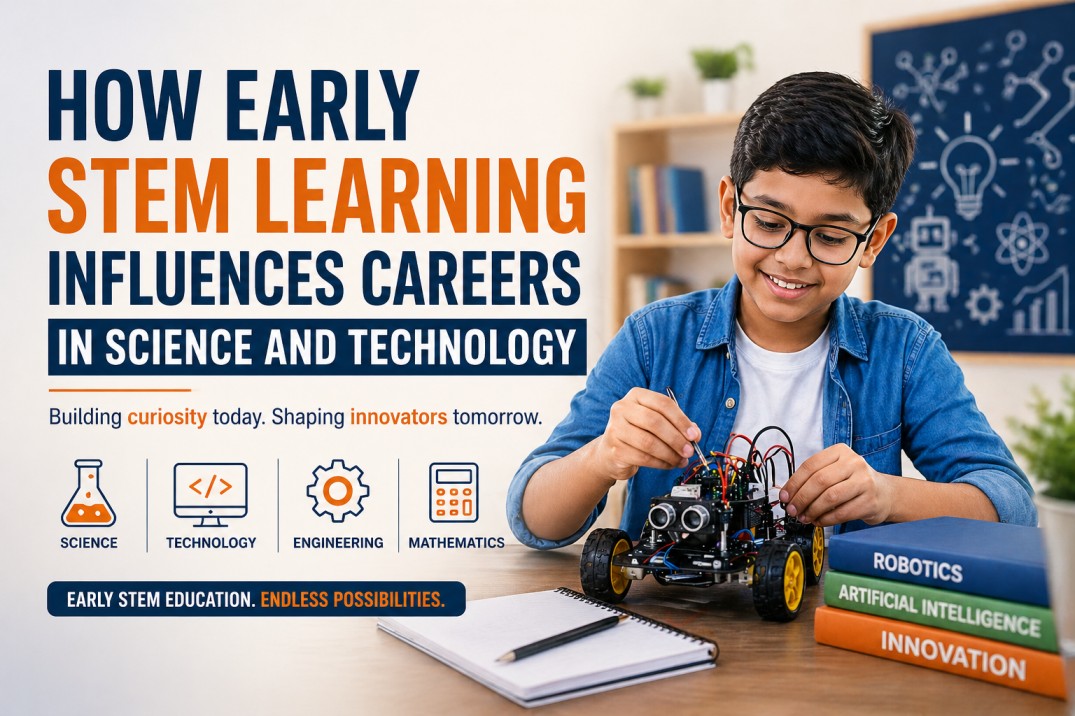
Introduction
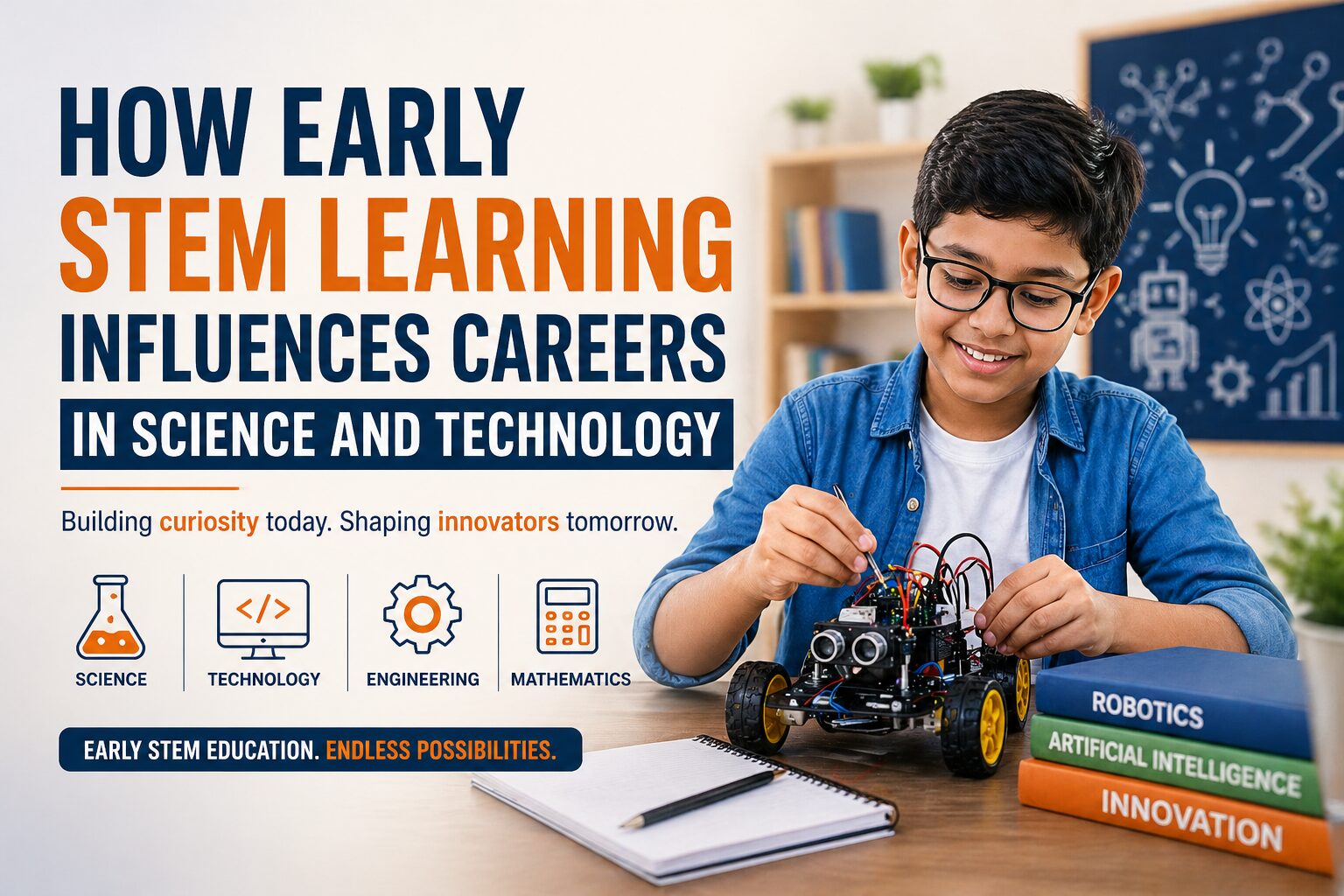
Ask any successful engineer, data scientist, or robotics researcher when their love for technology started — and most of them will not point to a college lecture or a university lab. They will point to a moment much earlier. A science fair project in Class 5. A broken gadget they took apart just to see how it worked. A coding game they stumbled upon at age nine that suddenly made logic feel like play.
It is not a coincidence. Early STEM learning in India and across the world consistently shows up as one of the strongest predictors of whether a student eventually pursues and thrives in a science or technology career. The curiosity that gets sparked at age seven does not disappear — it compounds. It shapes how a child approaches problems, how comfortable they feel with technology, and ultimately what kind of future they choose to build for themselves.
Even with such knowledge in hand, most schools in India continue to approach both science and math as subjects to be studied but not experienced. The textbook takes precedence. Experimentation is infrequent. And the link between learning in class and technology’s reality in the outside world is frustratingly thin.
That gap is exactly what this blog is about. Let us talk about what early STEM education actually does to a child’s developing mind — and why the age at which a student first encounters hands-on science and technology learning matters far more than most parents and schools currently realize.
What Happens in a Young Brain During STEM Learning
Before we get into careers and outcomes, it helps to understand what is actually happening neurologically when a young child engages with a STEM activity — whether that is building a simple circuit, programming a robot to follow a path, or designing a structure that can hold weight.
Young children between the ages of five and twelve are in one of the most neurologically active periods of their lives. The brain is forming connections at a remarkable rate during this window. When a child is exposed to structured problem-solving — the kind that STEM education for kids in India provides through robotics kits, coding exercises, and engineering challenges — those neural pathways around logical thinking, sequential reasoning, and creative problem-solving get reinforced repeatedly.
The result is not just better performance in science class. Research from Tufts University shows that children as young as seven can master concepts as complex as conditional programming when introduced through the right tools. The brain at this age is not too young for technology — it is perfectly primed for it.
It implies that a child who experiences technological education through physical interaction between the ages of six and twelve develops a cognitive base that makes all future interactions with science, technology, and math seem more natural, easier to understand, and more enjoyable. A child who learns to program a robot at the age of eight will feel more comfortable entering an electronic laboratory at age sixteen than anxious.
The Career Connection: Why Early Exposure Shapes Long-Term Choices
Here is where things get genuinely important for parents and school leaders thinking about curriculum decisions.
Career choices in science and technology are rarely made rationally in the final years of school. They are made emotionally, based on identity. A student chooses engineering because somewhere along the way, they came to see themselves as someone who understands how things work. They chose computer science because coding stopped feeling foreign and started feeling natural. They pursue AI research because they spent formative years building things and solving problems — and that experience told them, repeatedly, that they could.
That identity — “I am someone who does science and technology” — is built through early experiences. And it is extraordinarily difficult to build after the age of fourteen if no foundation was laid earlier.
STEM career opportunities in India are growing at a pace that is genuinely difficult to overstate. The World Economic Forum projects that 65 percent of children entering primary school today will work in jobs that do not yet exist. Most of those jobs will be built around artificial intelligence, robotics, data science, biotechnology, and engineering. India specifically is seeing explosive demand for professionals in AI, embedded systems, IoT, and software development — with the talent pipeline struggling to keep up.
The students who will fill those roles are sitting in classrooms right now. The question is whether their schools are giving them the early experiences they need to recognize themselves as the future engineers and scientists India needs.
What Early STEM Learning Actually Looks Like in Practice
It is worth being specific here, because “STEM education” has become one of those terms that can mean almost anything — from a coloring activity with a science theme to a rigorous, hands-on robotics curriculum.
There are some distinct features of real early STEM learning. First, it is project-based, which means that students do some sort of project instead of merely being consumers of knowledge. Second, it involves trial and error, because children have to experiment, fail, improve, and repeat this process. Third, it is problem-based – students should learn how to solve practical problems with the use of what they know.
For a six-year-old, this might look like using a robot toy to understand the concept of sequencing — giving it instructions in order to achieve a goal. For a ten-year-old, it might mean building a basic weather station using an IoT kit that measures temperature and humidity and sends data to a screen. For a thirteen-year-old, it might mean writing Python code to make a robot navigate a maze autonomously.
Each of these experiences does something that a textbook chapter on the same topic simply cannot do. It makes the concept real. It gives the student ownership over the learning. And it builds the kind of confidence that compounds over the years into a genuine technical identity.
That is because robotics education among children in India has evolved from being an exclusive activity to becoming an essential part of the learning process, and schools that focus on providing proper STEM courses have been found to generate better results among their students overall in science and mathematics.
The Role of Parents in Supporting Early STEM Interests
School programs matter enormously. But so does what happens at home. And one of the most consistent findings in STEM education research is that parental attitude toward science and technology shapes a child’s relationship with those subjects almost as powerfully as school instruction does.
Children pick up on signals very quickly. When a parent treats a math problem as something to be feared or a technology question as something to be avoided, a child receives a message about what kind of person engages with those subjects. Conversely, when parents treat curiosity about how things work as something worth encouraging — when they take apart a broken appliance together, when they look up how a bridge is built, when they sit alongside their child during a coding activity — they are actively reinforcing a STEM identity.
For parents wondering how to support early engagement without being experts themselves, the most powerful thing is simply curiosity modeled out loud. Ask questions. Celebrate attempts over outcomes. Acknowledge that you do not know the answer and explore it together. These habits of mind are exactly what STEM education is trying to build — and they are built most powerfully when they show up both in school and at home.
Skills That Early STEM Builds – And Why Employers Value Them
There is a reason the conversation about STEM careers goes far beyond science and engineering companies. The skills that come from quality early STEM education — computational thinking, structured problem-solving, resilience through failure, collaborative design — are exactly the skills that employers across every sector are struggling to find in 2026.
Future-ready skills for students are not just about knowing how to code or build a robot. They are about knowing how to approach a problem you have never seen before. How to break it into smaller parts. How to test a hypothesis. How to work with a team when no one has the answer yet. These are the skills that make someone genuinely valuable in a technology-driven workplace — and they are skills that are built through years of practice, not learned in a single course.
A student who has spent years building projects, competing in STEM competitions, debugging code at age eleven, and iterating on designs that did not work the first time arrives at the workplace — or at engineering college — with a maturity of thinking that their peers who only studied theory simply do not have.
It is the compounding return on early STEM investment. It is not just about what a child learns. It is about who they become through the process of learning it.
How NEP 2020 Is Pushing India in the Right Direction
India’s National Education Policy 2020 has placed significant emphasis on experiential learning, critical thinking, and the integration of technology into K-12 education from the early years. The policy specifically recommends introducing computational thinking and coding from Class 3 onwards — a recognition that the age at which students first encounter structured technology learning has been far too late in the traditional Indian school model.
This rush for the implementation of NEP 2020 STEM by early learners presents schools with an advantage and also responsibility at the same time. Schools that embrace the process and establish programs in STEM education in accordance with the framework provided in the policy will enjoy a distinct advantage over others. The schools that adopt a passive attitude towards compliance with NEP 2020 STEM will see the disparity in results increase with time.
What STEM-Xpert Is Building for India’s Young Learners
At STEM-Xpert, the conviction driving everything we do is simple. Every child in India deserves access to the kind of learning experience that makes science and technology feel possible, exciting, and personally relevant — not in college, not in Class 11, but from the very beginning of their school journey.
Our robotics and AI courses for kids are designed to meet students exactly where they are — building foundational skills in early grades and advancing systematically through coding, IoT, artificial intelligence, and engineering design as students grow. Our STEM Innovation Kit — India’s first IoT-enabled STEM kit — gives students the tools to build real working systems from home automation models to weather stations, making technology tangible in a way that no textbook can replicate.
Because we know, from seven years of working with more than 50,000 students across India, that the child who builds something real at age ten is far more likely to become the engineer, researcher, or innovator at age twenty-five that India is counting on.
Conclusion
The results of the study are consistent, the testimonies are consistent, and the message rings clear: When children are exposed to high-quality STEM learning early in life, the benefits extend far beyond better academic performance. Identity, skill development, and career opportunities become lifelong realities.
If there is one thing that parents, school leaders, and education policymakers should take from everything in this blog, it is this: the best time to invest in a child’s STEM journey is not when they are choosing their stream in Class 10. It is right now — wherever they are in their school journey — because every year of quality STEM learning builds on the last.
The engineers and scientists India needs in 2040 are children today. How we educate them in the next five years will determine what they are capable of building in the next thirty.
FAQs
Q1. How does early STEM learning influence a child’s career in science and technology?
Early STEM learning develops problem-solving and logical thinking skills that build confidence in science and technology. Children exposed to hands-on activities are more likely to pursue related careers in the future.
Q2. What is the best age for children to start STEM learning in India?
Children can begin basic STEM learning through play-based activities around age five. The most effective period for building strong skills is typically between ages six and twelve.
Q3. Why is STEM education important for school students in India?
STEM education helps students develop critical thinking, creativity, and technical skills needed for modern careers and higher education opportunities.
Q4. How does robotics help children build future-ready skills?
Robotics encourages hands-on learning where children design, build, and test solutions. This process strengthens teamwork, problem-solving, and logical thinking skills.
Q5. What career options are available after early STEM education in India?
Early STEM learning can lead to careers in fields such as software development, robotics, data science, engineering, healthcare, and entrepreneurship.
Q6. How is NEP 2020 changing early STEM education in Indian schools?
NEP 2020 promotes hands-on learning, coding, and skill-based education from early grades, encouraging schools to introduce practical STEM experiences at a younger age.

 Sri dharan
 Gayathri Digital