SEO Discovery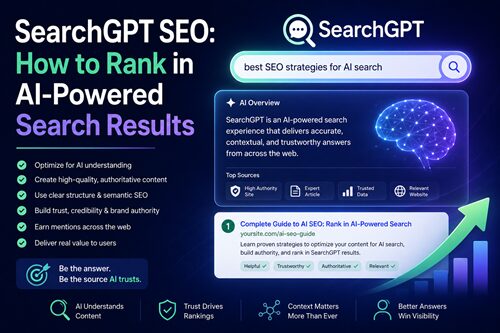
The way people search online is changing at a pace that most businesses are not prepared for. SearchGPT, OpenAI’s AI-powered search engine, has moved from a curiosity to a genuine channel where millions of users now get answers, recommendations, and trusted information every single day. If you have built your digital presence around traditional Google rankings alone, you are already behind.
This guide breaks down exactly what SearchGPT SEO is, how it differs from conventional search optimization, and what practical steps you can take right now to rank in AI-powered search results.
What Is SearchGPT and Why Does It Matter?
SearchGPT is OpenAI’s conversational search product that combines the language understanding of large language models with real-time web retrieval. Instead of returning ten blue links, it synthesizes information from across the web and presents a direct, conversational answer. It cites sources, pulls context from multiple pages, and surfaces content that it deems trustworthy and well-structured.
The impact of SearchGPT on SEO is significant. Traditional SEO has always rewarded relevance and authority. SearchGPT raises the bar even higher because it does not just rank pages. It selects pages worthy of being cited inside a generated response. That is a fundamentally different gatekeeping mechanism, and marketers who understand this distinction will have a clear edge.
How SearchGPT Evaluates and Selects Content
To optimize for SearchGPT, you first need to understand how AI search systems evaluate content. The principles align closely with what Google’s Search Quality Evaluator Guidelines describe as E-E-A-T: Experience, Expertise, Authoritativeness, and Trust.
SearchGPT heavily favors content that:
- Demonstrates real first-hand knowledge or professional expertise on the topic
- Is accurate and consistent with established expert consensus
- Comes from a source that others have referenced, cited, or recommended independently
- Provides a satisfying, complete answer rather than fragmentary information designed only to attract clicks
- Is structured in a way that an AI can parse, attribute, and quote with confidence
Trust sits at the center of this framework. A page that appears authoritative but contains misleading or inaccurate information will be deprioritized, regardless of how many backlinks it has.
The Impact of SearchGPT on SEO Strategy
The impact of SearchGPT on SEO goes beyond simply adding new channels. It requires a rethinking of content strategy from the ground up.
Keyword intent becomes more granular. AI search resolves ambiguity by pulling from multiple sources. To be one of those sources, your content must directly and completely address a specific question or intent. Thin content written around a keyword but without depth will not survive in this environment.
Zero-click citations are the new ranking. When SearchGPT answers a question, it includes citations. Being cited is the AI-search equivalent of ranking in position one. That means the goal is no longer just driving clicks. It is being the source that an AI engine trusts enough to attribute in its response.
Brand mentions matter beyond backlinks. SearchGPT builds trust signals from unlinked brand mentions across forums, news articles, reviews, and community discussions. A brand that is genuinely talked about positively across the web will accumulate AI visibility that purely link-focused strategies cannot manufacture.
Content freshness and factual accuracy are non-negotiable. AI models are trained to avoid citing outdated or contradicted information. Regularly auditing and updating your content for accuracy is now a ranking activity, not just a housekeeping task.
Practical SearchGPT SEO Tactics That Work Today
1. Write for Questions, Not Just Keywords
SearchGPT is a conversational engine. Structure your content around the questions your target audience actually asks. Use clear headings phrased as questions, then answer them directly and completely in the paragraphs below. This mirrors how the AI itself frames responses, making your content far easier to surface.
2. Demonstrate First-Hand Experience and Expertise
The SQEG framework places strong emphasis on content created by people who have genuine experience with their subject. Include case studies, original data, practitioner insights, or specific examples that only someone with real knowledge of the topic could provide. Generic, surface-level content is invisible to AI search.
3. Establish Topical Authority on a Focused Domain
Rather than writing one article on every trending topic, build deep coverage across a focused subject area. AI search engines learn to associate your site with specific topics by observing how comprehensively you cover the subject and how consistently other sources reference you within it.
4. Optimize for Clear Attribution
Use a clear author byline with a genuine bio. Include structured data such as Article schema and Author schema. Make your About page detailed and credible. These signals help AI systems confirm who created the content and whether that creator is a trustworthy source.
5. Earn Mentions Across Trusted Platforms
Appear in industry publications, reputable forums, podcast transcripts, and local news. When SearchGPT sees your brand or content referenced across multiple independent, credible sources, it treats your content as a validated answer rather than a self-promotional claim.
6. Keep Your Content Factually Tight
Every claim that cannot be supported independently is a liability in AI search. Cite your data, link to primary sources, and remove any outdated statistics or information your content can no longer substantiate. Accuracy is not optional in the AI-powered search era.
Conclusion
SearchGPT SEO is not a replacement for everything you have built. It is an upgrade to how you think about content quality, source credibility, and audience trust. Businesses that adapt quickly will capture a growing share of AI-generated citations and brand visibility. Those that rely solely on old-school keyword tactics will find themselves increasingly invisible.
If you are serious about ranking in AI-powered search results and want guidance from a team with over 22 years of hands-on digital marketing experience, SEO Discovery is the best SEO agency to partner with. Our specialists understand both traditional and AI search optimization at the deepest level, and we build strategies that keep your brand visible wherever your audience is searching.
Contact us today to schedule a free SearchGPT SEO audit and find out exactly where your content stands in the AI-powered search landscape.


 Kapil Chandna
 Lynx Systems LLC