claire miller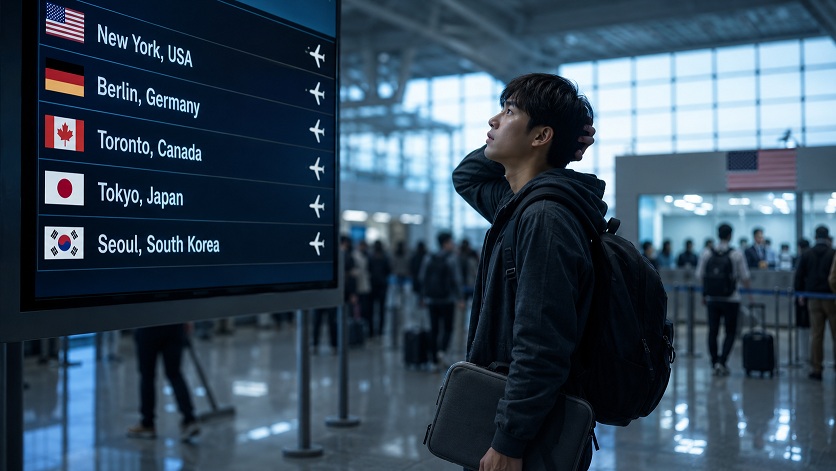
For decades, the phrase “American Dream” carried a special meaning for international students.
It represented access to elite universities, cutting-edge research, career growth, and the possibility of building a future in one of the world’s largest economies. For students across India, China, South Korea, and other Asian countries, studying in the United States was often viewed as the ultimate educational achievement.
In 2026, that perception is being tested.
The United States still offers exceptional universities and unmatched research opportunities. Yet a growing number of Asian students are questioning whether the rewards are worth the uncertainty. Visa concerns, changing immigration policies, and unpredictable post-study pathways are forcing students to rethink assumptions that guided study-abroad decisions for generations.
A Dream Built on Opportunity
The popularity of the United States was never based solely on university rankings.
Students were attracted by an entire ecosystem. A degree from an American institution could lead to internships, professional networks, advanced research opportunities, and valuable work experience after graduation.
This combination made the U.S. stand out from competing destinations. Students did not simply enroll for a classroom experience. They invested in a future.
That future feels less certain today. Proposed visa changes, debates around work authorization, and stricter immigration enforcement have created doubts about whether the traditional pathway from student to professional remains as accessible as it once appeared.
Why Students Are Looking Beyond America
One of the most significant education trends of 2026 is the rise of alternatives.
Students who once focused exclusively on the United States are now actively exploring Europe and Asia. Germany attracts attention for its affordability and engineering opportunities. Ireland and the Netherlands offer growing technology sectors. Singapore, Japan, and South Korea combine strong universities with thriving regional economies.
This shift is not driven by anti-American sentiment. It is driven by practical decision-making.
Families making large financial commitments want confidence that policies will remain stable throughout a student’s educational journey. When uncertainty increases, alternative destinations become more attractive.
In many cases, students are not rejecting the United States. They are simply refusing to depend on it as their only option.
Reputation No Longer Guarantees Preference
University rankings remain important, but they are no longer enough.
Today’s students evaluate a destination using a broader set of criteria. They want to understand work rights after graduation, visa renewal processes, safety concerns, and long-term career prospects.
A highly ranked university may still lose out to a slightly lower-ranked institution in a country with more predictable immigration policies. This would have seemed surprising a decade ago. Today, it is increasingly common.
The change reflects a more mature approach to international education. Students are treating their education like a major investment and assessing risk accordingly.
The Students Who Adapt Best
Interestingly, the uncertainty is also producing a positive trend.
Students are becoming more strategic planners.
Rather than relying on a single university or country, many now create multiple pathways. They apply to several destinations, research immigration rules carefully, and build skills that remain valuable regardless of location.
Academic performance plays a critical role in this strategy. Strong grades, technical skills, and practical experience create flexibility when circumstances change.
This is why many students use additional learning resources throughout their studies. Platforms like Expertsmind.com that connect learners with subject specialists can help students strengthen difficult subjects, improve assignment quality, and maintain the academic performance needed to compete internationally.
In a world where policies can change quickly, strong academic credentials remain one of the most reliable assets a student can possess.
The Future of Global Student Mobility
The American Dream is not disappearing.
The United States continues to attract talented students from around the world, and its universities remain global leaders in research and innovation. What is changing is the assumption that America is automatically the best choice for everyone.
Students now have more information, more options, and a stronger awareness of risk. They are comparing countries based on the complete student experience, not just institutional prestige.
As a result, the future of global education may become more balanced. Instead of one dominant destination, students will spread across a wider range of countries that offer different combinations of opportunity, affordability, and stability.
The biggest lesson from 2026 is simple. The American Dream still exists, but it is no longer the only dream available. For many Asian students, the smartest choice is no longer the most famous destination. It is the destination that offers the strongest foundation for their future.


 james hat
 Ethan Brooks